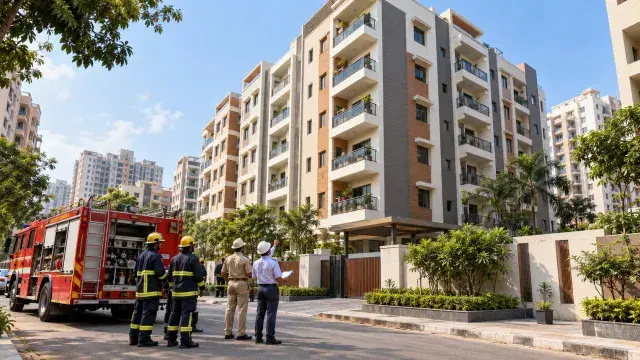

The state fire department has taken a key decision regarding newly constructed residential apartments in Telangana. The minimum height limit required for a provisional fire no objection certificate (NOC) to be obtained before construction of a building has been increased from 18 meters to 24 meters. Fire department officials said that this revised provision will come into effect from October 7.
According to the existing rules, residential buildings of 18 meters or more in height had to obtain a fire NOC before construction permission was granted. With the latest change, apartments between 18 and 24 meters in height (about 5 to 7 floors) will not need to obtain a provisional NOC just because of their height. However, this relaxation is applicable only to residential buildings. The officials clarified that the existing fire safety norms will continue for other buildings like schools, hospitals, hotels, hostels, commercial complexes, offices and industries.
Officials said the decision was taken in consultation with builders' associations and in line with the recently implemented National Building Construction Standards (NBCS) 2026. The Bureau of Indian Standards replaced the National Building Code of India 2016 on April 30. The new national standards have set a height of 24 metres as an important benchmark for fire safety in residential buildings.
The main objective of this change is to reduce the regulatory burden on low and medium-rise residential buildings and simplify the permitting process, explained Vikram Singh Mann, Director General of Telangana Fire Services. Despite
expert warnings
, officials have said that buildings that do not fall under the scope of the NOC will not be exempted from basic fire safety standards. They said that during construction, random inspections will be conducted to check arrangements such as safe exit routes, emergency lighting, fire extinguishers and electrical safety.
Responding to this issue, Council for Fire and Life Safety Vice President S.P. Anchuri warned that the height of the building alone does not determine the severity of the fire. He suggested that many factors such as density of residents, evacuation arrangements, smoke control systems (smoke management), and ways for fire tenders to enter the building should be considered. He emphasized that even in buildings of 18 to 24 meters in height, there must be safe stairs, emergency lighting, fire alarm systems, and adequate fire extinguishing equipment. Experts are concerned that closing stairwells and terraces in apartments, storing supplies in common areas, unauthorized electrical changes, and parking vehicles across fire tenders can lead to major accidents. They suggest that the safety standards established during construction should be continuously followed even after the residence is started.
According to Times of India statistics, there were over 8,860 fire accidents in Telangana in 2025. Over 160 people died in these. In this context, experts are warning that there should be no negligence in safety standards.
Fire NOC for apartments in Telangana.. Exemption up to 24 meters